
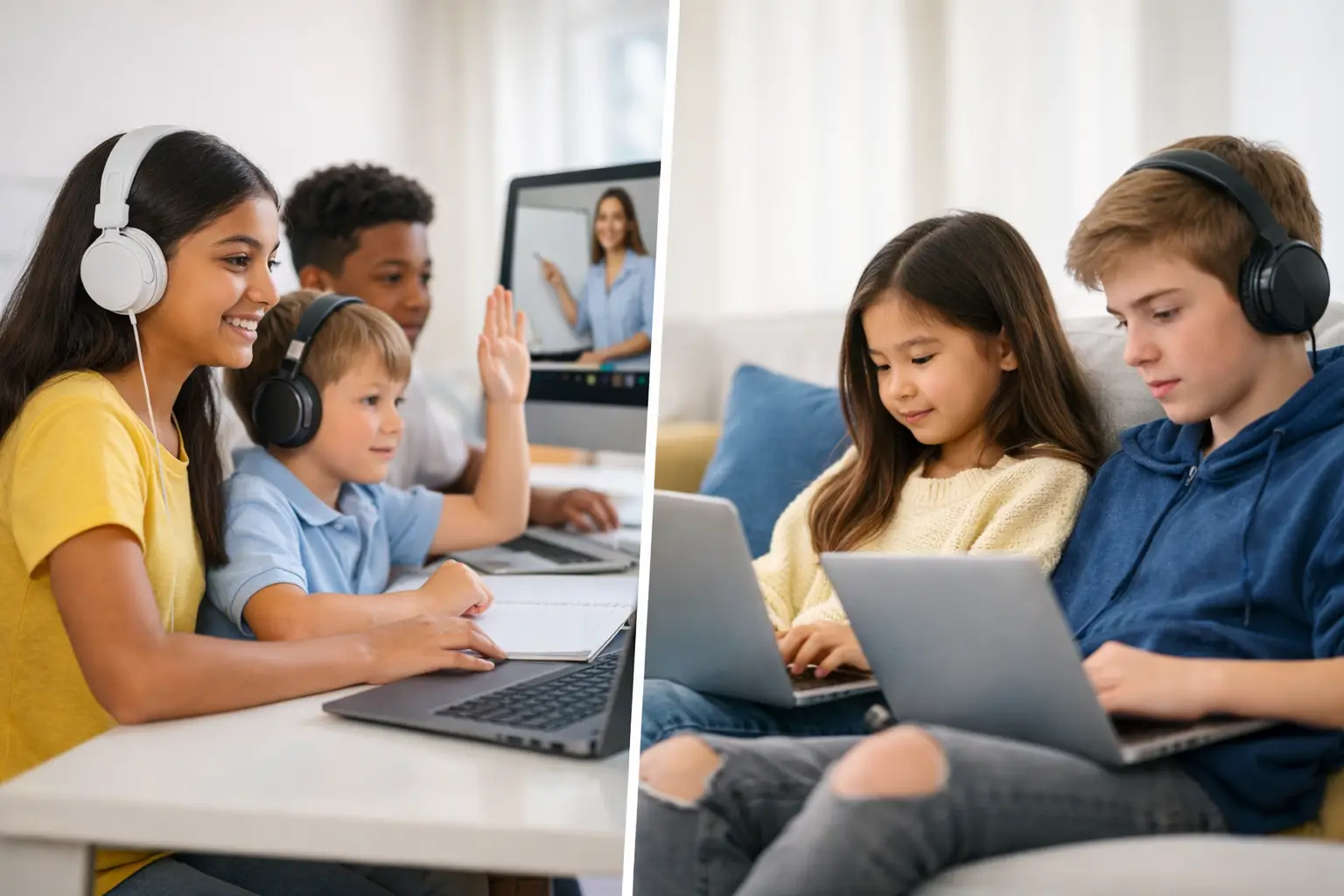
A child may complete every assigned video, tick every box and still feel unseen. That is the central question in live lessons vs self-paced learning: not simply whether a pupil can access work online, but whether they are being properly taught, known and challenged as they learn.
For families considering online education, flexibility matters. A timetable must work around international moves, training schedules, health needs or a different family rhythm. Yet flexibility should not mean handing a child a library of content and hoping they can independently turn it into understanding. The right model depends on a child’s age, confidence, learning habits and academic ambitions – but the difference between the two approaches is significant.
Live lessons vs self-paced learning: the essential difference
Live learning is scheduled teaching delivered in real time. Pupils attend lessons with a qualified teacher and classmates, contribute to discussion, ask questions, complete work and receive feedback as misconceptions arise. It follows the familiar rhythm of school, while making education accessible from wherever a family happens to be.
Self-paced learning gives pupils materials to work through independently, usually in the form of recorded videos, reading, quizzes and assignments. They may be able to choose when they study and move quickly through subjects they find straightforward. Teacher contact can range from occasional check-ins to none at all.
Neither model is automatically right or wrong. A motivated older student may use self-paced resources well for targeted revision or an additional interest. However, a complete school education asks much more of a child than content consumption. It requires a carefully sequenced curriculum, expert explanation, regular assessment, meaningful relationships and support when learning or wellbeing begins to wobble.
Why real-time teaching changes the learning experience
The strongest case for live lessons is not that a teacher is visible on screen. It is that teaching becomes responsive.
When a Year 5 pupil hesitates over equivalent fractions, or a GCSE student applies the wrong method to a chemistry calculation, a skilled teacher can spot the issue immediately. They can rephrase an explanation, use a different example, ask a diagnostic question or provide additional practice before the misunderstanding becomes embedded. Recorded content cannot read the room. A quiz can identify an incorrect answer, but it cannot always reveal why the answer was wrong.
Live teaching also creates accountability without making learning feel punitive. Children know when lessons begin, what preparation is expected and who will notice if they are unusually quiet, distracted or absent. This routine is particularly valuable for younger pupils, for students who are rebuilding confidence after an unsettled school experience, and for teenagers managing the growing demands of IGCSE or A-level study.
At Sophia High School, pupils benefit from 20-25 hours of live teaching each week, taught by fully qualified UK teachers in small classes. That level of contact reflects a simple principle: a premium online education should offer real teaching, not content delivery with occasional support attached.
Structure supports freedom
Self-paced programmes are often presented as the flexible option. They can be flexible, especially for a short course, revision period or an adult learner who already has strong independent study habits. For school-aged children, though, unlimited flexibility can quietly become delay.
Without a clear timetable, it is easy to postpone the subject that feels difficult, skim material without mastering it, or let a day’s work drift into the evening. Parents can find themselves becoming scheduler, motivator, technical support and subject tutor at once. That may not be why they chose online education.
A live timetable provides a dependable framework while still allowing a family to live differently. A high-performance athlete can train around school hours. An expatriate family can maintain continuity through a relocation. A pupil with health considerations can learn from a calmer home environment. The structure remains, but the physical commute and fixed campus location do not.
This distinction matters. Flexibility should give families more control over where and how they live, not transfer responsibility for a child’s education from school to home.
Feedback is more than a mark
Independent platforms can offer instant scoring, and this is useful for checking recall. But a score alone rarely gives a child the next step. If an essay lacks a clear argument, if handwriting obscures a calculation, or if a pupil has understood a novel’s plot but not its themes, progress depends on specific, human feedback.
In live lessons, feedback is woven through the day. Teachers hear how pupils explain their reasoning, observe how they approach unfamiliar tasks and adapt teaching accordingly. They can stretch a learner who is ready to go further or provide reassurance before a small difficulty becomes a larger barrier.
This is especially important at examination level. IGCSE and A-level success is not built by watching more videos. Pupils need to practise applying knowledge, respond to precise feedback and develop the confidence to articulate ideas under pressure. Regular teacher contact helps make that process visible to both students and parents.
The pastoral difference families can feel
Education is relational. A child who feels comfortable asking a question is more likely to persist. A teenager who knows an adult will notice a change in engagement is less likely to disappear behind a completed login record.
Self-paced learning can suit some highly independent students, but it can also be isolating. There is less natural opportunity for conversation, collaborative problem-solving and the everyday moments in which a teacher gets to know a pupil’s strengths and concerns. For children learning online full time, those connections deserve particular attention.
Live classes create a social learning environment. Pupils encounter different viewpoints, work with peers and practise communicating clearly. Small class sizes make it easier for every child to have a voice rather than becoming one name among hundreds of platform users.
Pastoral care is not separate from academic outcomes. A pupil who feels secure, included and understood is better placed to take intellectual risks, recover from mistakes and aim high.
When self-paced learning may be useful
There are sensible reasons to use self-paced resources alongside a live education. A pupil may revisit a topic before an assessment, explore coding or a language beyond the curriculum, or catch up on missed material after illness. Older students can also benefit from building independent study routines before university.
The key word is alongside. Self-paced materials work best as reinforcement, extension or revision within a broader school experience led by teachers. They are less convincing as a replacement for daily instruction, particularly for primary pupils and for teenagers working towards recognised qualifications.
Parents should also distinguish between a programme that is genuinely self-paced and one that is simply low-contact. If a school advertises flexibility, ask what happens when a child is confused, falls behind or loses motivation. Ask how often teachers teach live, how progress is assessed, whether classes are small, and who is responsible for pastoral support. The answers reveal far more than a polished learning platform ever can.
Choosing the right model for your family
Start with the child in front of you, not the promise of a particular format. A confident, self-disciplined sixth former may thrive with some independent learning built into their week. A younger child usually needs regular explanation, encouragement and routine. A bright pupil who has become disengaged may need the careful attention of a teacher, not more material to complete alone.
Then consider what you want from school beyond academic content. Is your priority recognised British curriculum pathways, preparation for IGCSEs and A-levels, regular communication with teachers, friendships with peers, or a clear safeguarding and support structure? A full education should meet those needs together, rather than asking families to assemble them from separate services.
The best online school experience does not force a choice between freedom and standards. It gives children a reliable school day, expert teaching and caring relationships, while allowing family life to reach beyond the limits of a physical campus. That is the kind of flexibility that helps a child move forward with confidence.