
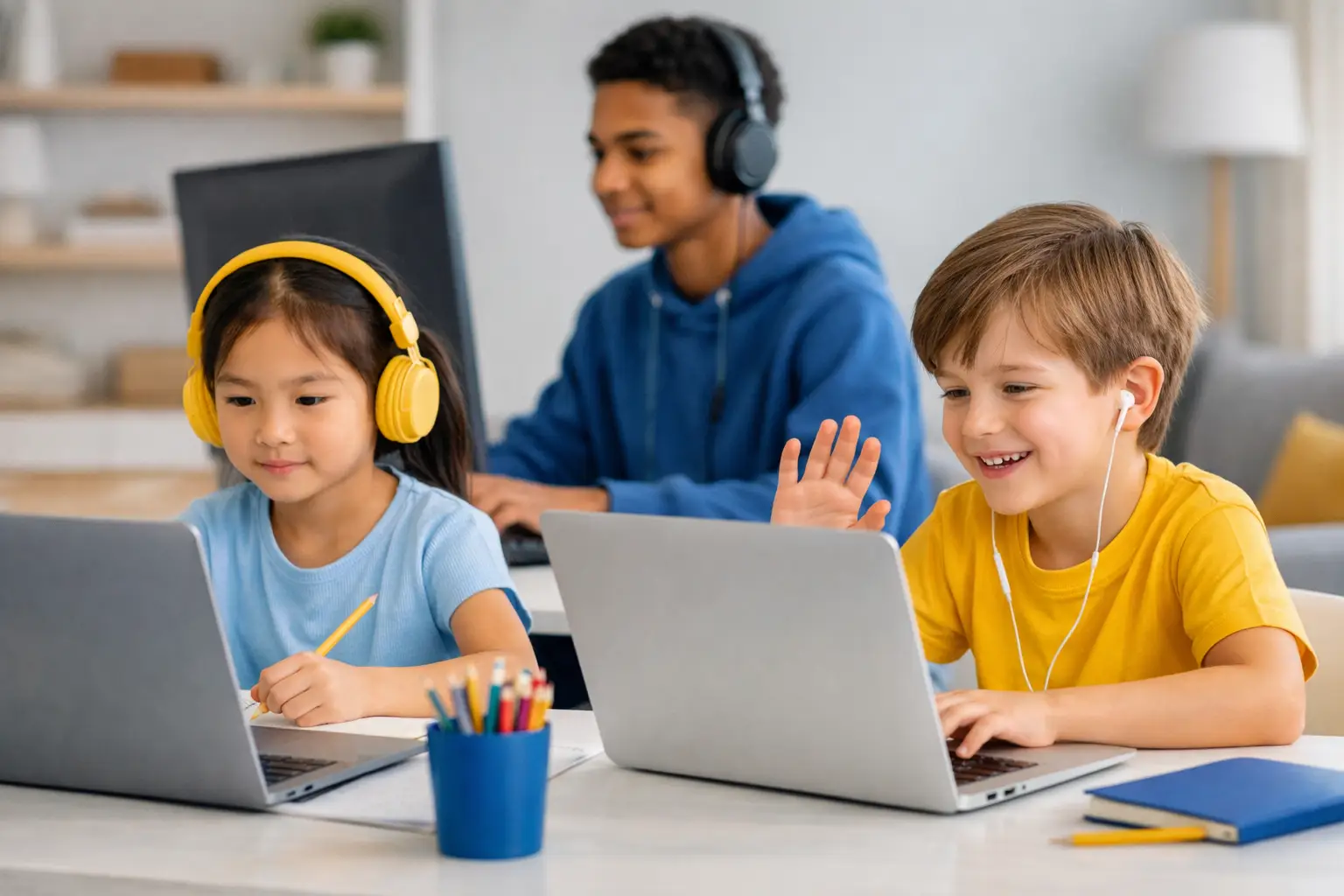
A seven-year-old does not need more content to click through. They need a teacher who notices the hesitant hand, peers who know their name, a clear routine and the confidence to ask, “Can you explain that again?” That is the real lens for answering the question: are online schools good for primary children?
They can be an excellent choice, but only when the online school is designed as a real school rather than a digital library. For younger children especially, quality rests on live teaching, trusted relationships, purposeful interaction and adults who understand how children learn. Flexibility matters, but it should never come at the cost of structure, safeguarding or academic ambition.
Are online schools good for primary children when teaching is live?
Primary education is foundational. Children are learning to read with fluency, reason with numbers, form friendships, manage emotions and become increasingly independent. These things develop through responsive teaching, not simply through completing tasks on a screen.
A high-quality online primary school therefore puts the teacher at the centre of the day. Lessons should be live and interactive, with children able to speak, contribute, show their work and receive feedback in the moment. A qualified teacher can spot a misconception in phonics, adjust an explanation in maths, invite a quieter pupil into the discussion or extend a child who is ready for greater challenge. Recorded videos and independent platforms may have a supporting role, but they are not a substitute for teaching.
The number of live teaching hours is a useful practical question for parents. A school offering a full, live-taught timetable of around 20 to 25 hours each week is providing a fundamentally different experience from one that mainly supplies resources for families to supervise. The former creates rhythm, accountability and relationships. The latter may suit some home-educating households, but it asks much more of parents and can leave children without regular connection to a teacher or class community.
Small classes matter just as much. In a large online group, it is easy for a child to remain unseen. In a carefully capped class, teachers have the time to learn each pupil’s strengths, needs and personality. That personal knowledge is particularly valuable in the primary years, when a child’s confidence can be shaped by whether they feel recognised and capable.
The benefits can be substantial for the right child and family
For many families, online schooling resolves a difficult compromise. A child may need the continuity of a British curriculum while living overseas, or a family may be relocating regularly. Others are seeking a calmer alternative to an overcrowded local school, without giving up academic standards or the social experience of learning with peers.
A well-run online school can offer a consistent education wherever a family is based. Rather than changing school, curriculum and friendship group with every move, a child can remain with familiar teachers and classmates. This continuity can be especially reassuring for expatriate families and globally mobile households.
There can also be greater scope for individual attention. Teachers working with small groups can adapt tasks, offer targeted support and provide appropriate stretch without making a child feel singled out. For a pupil who is finding conventional school challenging, that can restore a sense of security. For a highly able learner, it can prevent momentum from being lost.
Flexibility is another genuine advantage, although it is often misunderstood. It does not mean a child should learn whenever they happen to feel like it. Younger pupils thrive on predictable routines. The value lies in having a school day that can work around travel, training, health needs or family circumstances while retaining clear lesson times, expectations and teacher contact. This is why online education can be a strong option for young athletes, performers and families living across time zones.
Parents often appreciate greater visibility too. They can understand what their child is studying, receive regular communication and see progress more clearly. The aim is not to turn parents into teachers. It is to build a close partnership between home and school, with the teacher retaining responsibility for instruction and assessment.
What primary children still need from an online school
The screen is only the setting. A good school must still provide the ingredients of a rich childhood education: intellectual challenge, belonging, playfulness, care and meaningful contact with others.
Relationships and social confidence
Social development does not only happen in a playground. It happens when children take turns in a discussion, collaborate on a project, listen to a different viewpoint, share a success and learn how to recover from a mistake. Live classes give pupils regular opportunities to practise these skills with a stable peer group.
That said, parents should be realistic. An online school cannot replicate every informal interaction of a physical campus. Families should consider how their child will access friendships, sport, clubs, outdoor activity and community beyond the lesson timetable. The strongest arrangement is often one where online school provides academic and pastoral community, while local activities provide additional face-to-face experiences.
Safeguarding and pastoral care
Safeguarding online must be active, not assumed. Parents should expect clear policies, secure systems, age-appropriate supervision and staff who know how to respond when a child seems withdrawn, anxious or unsettled. Pastoral care is not an optional extra reserved for older pupils. A primary child who feels safe and understood is better placed to learn.
Ask how the school monitors attendance and engagement, how concerns are shared with families and who a child can turn to if they need help. Equally, ask whether teachers have the capacity to know children well. Care is most convincing when it is built into everyday contact rather than added only when a problem arises.
A broad and ambitious curriculum
Primary education should be about far more than literacy and numeracy, important though both are. Children need a coherent curriculum that includes science, humanities, creative subjects, computing and personal development. They need opportunities to be curious, to make connections and to discover what they enjoy.
For families seeking a British education, the National Curriculum for England offers a clear, progressive framework. However, curriculum documents alone do not guarantee quality. What matters is how knowledge is taught, revisited and assessed, and whether children are encouraged to think deeply rather than rush through activities.
How to decide whether an online school is right for your child
The question is not whether online learning is inherently good or bad. It is whether a particular school can meet your child’s academic, social and emotional needs at this stage of their development.
Start by looking beyond polished technology. Ask to understand a typical week. How many lessons are live? How large are classes? Are teachers fully qualified and experienced in primary education? How does the school teach early reading, writing and maths? What happens if a child needs extra support or greater challenge?
Then examine standards and accountability. Independent school accreditation, recognised inspection arrangements and clear safeguarding procedures give families valuable reassurance. They show that the school is accountable for more than its marketing claims. If a school offers an established route through the British curriculum, including later IGCSE and A-Level pathways, it can also provide confidence that a child’s education has continuity as they grow.
It is worth considering your own family routine with honesty. A child will need a quiet, suitable learning space, reliable internet and an adult who can help establish healthy habits, particularly in the early years. They should have breaks away from the screen, time for movement and opportunities to play. The best online school will guide this balance rather than expecting children to remain passive at a desk for long stretches.
Finally, involve your child in the decision. A trial lesson or conversation with staff can reveal a great deal. Do they appear comfortable speaking to the teacher? Are they intrigued by the class? Can they imagine belonging there? A little initial nervousness is normal, but genuine engagement is a promising sign.
Real teaching, not content delivery
The difference between online schooling and online content is decisive. A folder of worksheets cannot respond to a child’s question. An algorithm cannot always recognise when a pupil has understood the answer without understanding the idea. For primary children, learning is relational.
At Sophia High School, this principle is reflected in a full live-taught British education, small classes and qualified UK teachers who combine academic rigour with close pastoral attention. For families who need global access without lowering their expectations, that model offers both flexibility and the disciplined care of an independent school education.
The right online school should leave a primary child feeling more than occupied. They should feel known, challenged, included and excited to return to class tomorrow.